Performed by our specialist team at Shreedeep Hospital
Stitchless cataract surgery in Ahmednagar represents the advanced technique for removing clouded lenses and restoring clear vision without traditional sutures. This minimally invasive procedure uses micro-incisions that self-seal, eliminating the need for stitches and significantly reducing recovery time and post-operative complications. Our specialist team at Shreedeep Hospital specializes in this modern approach, ensuring patients experience minimal discomfort and rapid visual rehabilitation.
We believe in honest, upfront disclosure so you can make an informed decision.
A step-by-step look at what happens during this procedure.
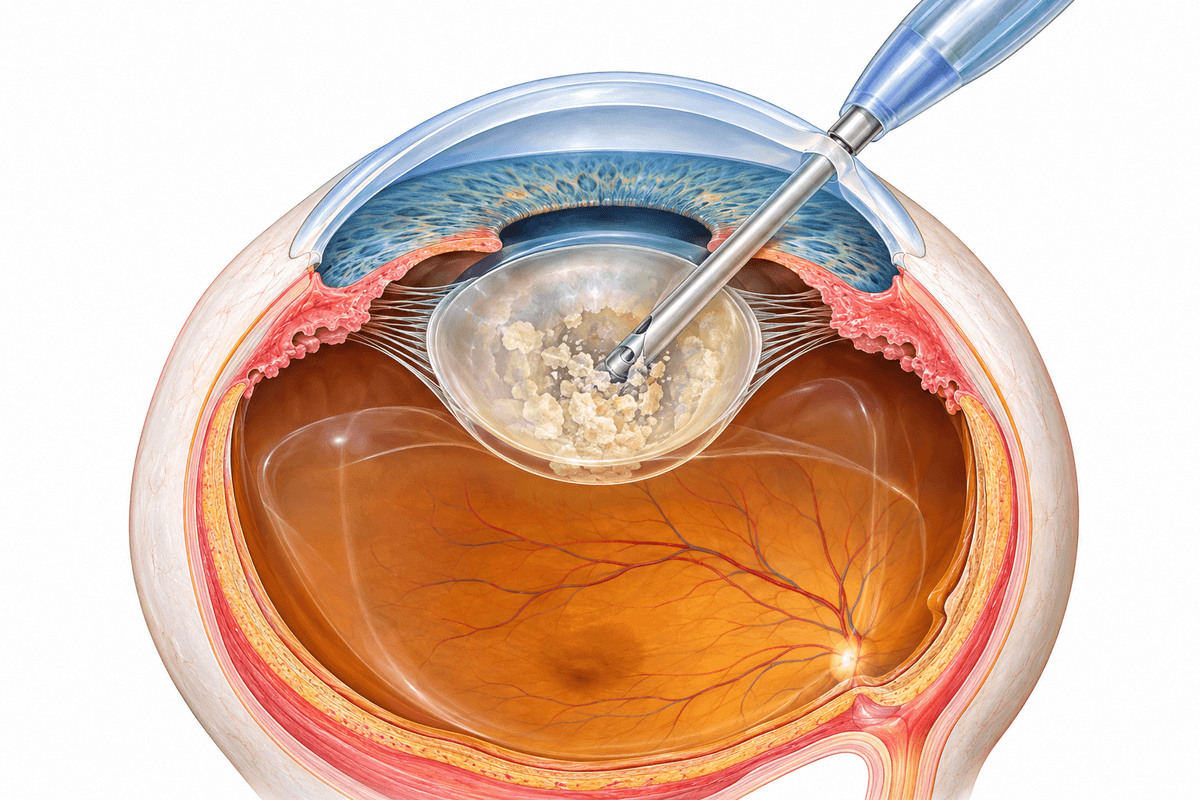
A self-sealing micro-incision of 2.2-2.8mm is created at the corneal edge using precise instruments, eliminating the need for stitches as the incision naturally closes after surgery.
Ultrasonic energy is used to break up the clouded cataractous lens into tiny fragments, which are then gently aspirated out through the micro-incision with minimal trauma to surrounding tissue.
The fragmented cataractous lens material is completely removed from the lens capsule while preserving the natural capsular bag that will support the artificial lens implant.
A foldable premium intraocular lens is inserted through the same micro-incision and carefully positioned within the preserved capsular bag to restore clear vision and proper focusing ability.
The micro-incision naturally self-seals without requiring any sutures due to its precise architecture and size, promoting faster healing and reducing the risk of infection and astigmatism.
A structured, patient-first approach from first consultation to full recovery.
Shreedeep Hospital conducts comprehensive biometry, corneal topography, and optical coherence tomography to precisely calculate the ideal intraocular lens power and customize the surgical approach for each patient's unique eye anatomy.
Our specialist team utilizes the latest phacoemulsification technology with micro-coaxial systems and advanced fluidics to ensure smooth lens removal with minimal ultrasonic energy, protecting delicate eye structures throughout the procedure.
Our facility offers a comprehensive range of premium intraocular lenses including monofocal, multifocal, toric, and extended depth of focus lenses, allowing patients to achieve their desired visual outcomes and reduce dependence on glasses.
Shreedeep Hospital provides detailed follow-up protocols with multiple checkpoints to monitor healing, manage medications, and ensure good visual recovery while addressing any concerns promptly to maximize patient satisfaction and outcomes.
What to expect at each stage of your recovery journey.
Within the first 24-48 hours, patients experience minimal discomfort with protective eye shield in place. Vision begins improving immediately, though may be slightly hazy. Prescribed antibiotic and anti-inflammatory eye drops must be used as directed to prevent infection and reduce inflammation.
During the first week, vision clarity progressively improves with most patients achieving functional vision for daily activities. Avoid strenuous activities, swimming, and eye rubbing. Continue prescribed medications and attend scheduled follow-up appointments to monitor healing progress.
Over 4-6 weeks, the eye fully heals and vision stabilizes to its optimal level. Most patients achieve 20/20 or near-20/20 vision depending on pre-existing eye conditions. Final glasses prescription, if needed, is determined after complete healing and visual stabilization.
Most patients achieve significantly improved vision, enabling them to perform daily activities like reading, driving, and recognizing faces without the cloudiness caused by cataracts.
The stitchless technique allows for faster visual recovery with most patients noticing improvement within 24-48 hours and returning to normal activities within one week, compared to traditional sutured methods requiring longer healing.
The self-sealing micro-incision maintains corneal integrity and induces negligible astigmatism, resulting in better optical quality and reducing the need for corrective glasses for distance vision compared to larger sutured incisions.
The sutureless approach eliminates stitch-related complications such as foreign body sensation, infection, and induced astigmatism, while the smaller incision reduces risks of wound leakage and promotes faster, more comfortable healing.
Let's clear up some of the most common myths about stitchless cataract surgery.
Get a personalised assessment from an experienced specialist. Understand your options, ask your questions, and decide with confidence.